Loading...
When comparing Dubai’s real estate market to other major cities, several factors come into play, including average price per square foot, rental yields, and overall market dynamics. One of the first things that come to mind when thinking of Dubai’s real estate market, is the risk of a so called bubble. The following report is from UBS global, which is a multinational investment bank, that offers financial services and manages most of the world’s billionaires’ wealth.
UBS, being as big as it is, has insights to the most accurate data of real estate markets all over the world. So, let’s assess their latest bubble index report together, shall we? The first thing we need to know to understand this report, is to understand what exactly ‘’bubblerisk’’ means.
‘’ Price bubbles are a recurring phenomenon in property markets. The term “bubble” refers to a substantial and sustained mispricing of an asset, the existence of which cannot be proved unless it bursts. But historical data reveals patterns of property market excesses. Typical signs include a decoupling of prices from local incomes and rents, and imbalances in the real economy, such as excessive lending and construction activity. The UBS Global Real Estate Bubble Index gauges the risk of a property bubble on the basis of such patterns. The index does not predict whether and when a correction will set in. A change in macroeconomic momentum, a shift in investor sentiment, or a major supply increase could trigger a decline in house prices. ‘’ Althus UBS
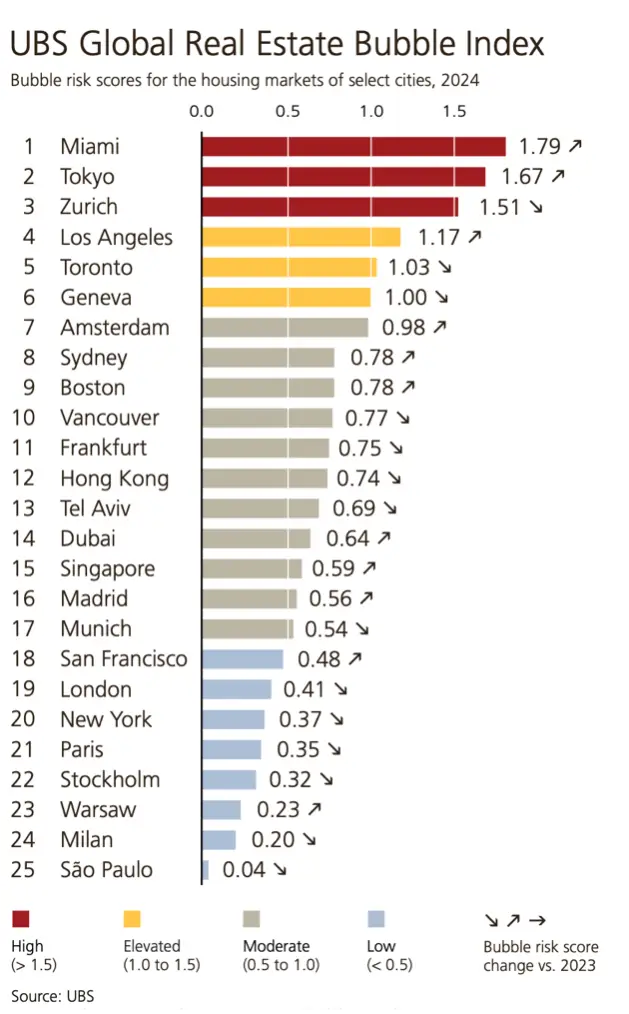
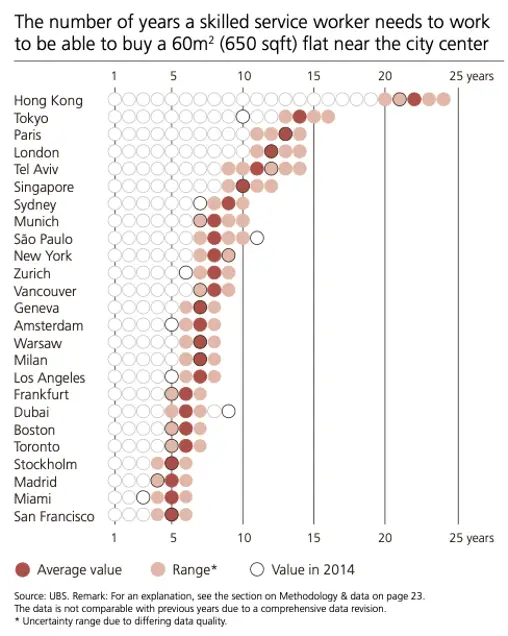
Price-to-income is of great value when assessing a market’s stability, as it shows how affordable homes are relative to what people actually earn. If the property prices grow faster than the average income does, fewer people can afford to buy a home, which results in a decline of demand and may lead to a price correction.
Fortunately however, income growth has been robust throughout the years as Dubai’s economy is rapidly growing to become one of the, if not THE economical capital of the world. As we can see in the graph, it is still relatively affordable for the average skilled worker to buy an apartment near the city center. This shows that even though property-prices have surged the past few years, the average wage was still able to keep up with that pace, implying that the market still has significant room for growth.
Also, we must not forget that Dubai’s no income tax policy plays a crucial role in maintaining a healthy price-to-income ratio. Unlike cities where high income taxes reduce take-home pay, Dubai allows employees to keep their full salaries, making homeownership more accessible. For employers, the absence of income tax reduces payroll burdens, enabling competitive salaries that attract top talent. This financial advantage supports a stronger purchasing power, ensuring steady demand in the real estate market and contributing to its long-term stability.
Unlike cities like New York, London or Paris, where homeownership near the center is out of reach for most, Dubai’s price-to-income ratio still allows many residents to buy apartments in prime locations. Due to this balance between earnings and property costs, we can conclude that Dubai offers sustained demand and long-term market stability.
Dubai once again claims its spot as the best performing city in the world when it comes to price growth, achieving a staggering 17% year-on-year increase on average. This price increase might signal the end of a bull run, you might think. Well, you’d be wrong. The market remains in a healthy growth phase rather than overheating. Unlike cities facing high bubble risks, Dubai’s price surge is backed by strong demand, economic expansion, and a favorable price-to-income ratio like we just discussed.
This price increase is also triggered by a big interest from foreign investors, who are attracted to the tax-friendly environment and investor-friendly legal system. Laws and regulations like zero property tax, no capital gains tax, and no rental income tax make Dubai very attractive for investors all over the globe.
Additionally, residency incentives like the Golden Visa encourage long-term investment, bringing in high-net-worth individuals looking for stability and financial advantages. Strong demand from international buyers, coupled with limited supply in prime areas, has further accelerated price appreciation, positioning Dubai as a leading global real estate hub.
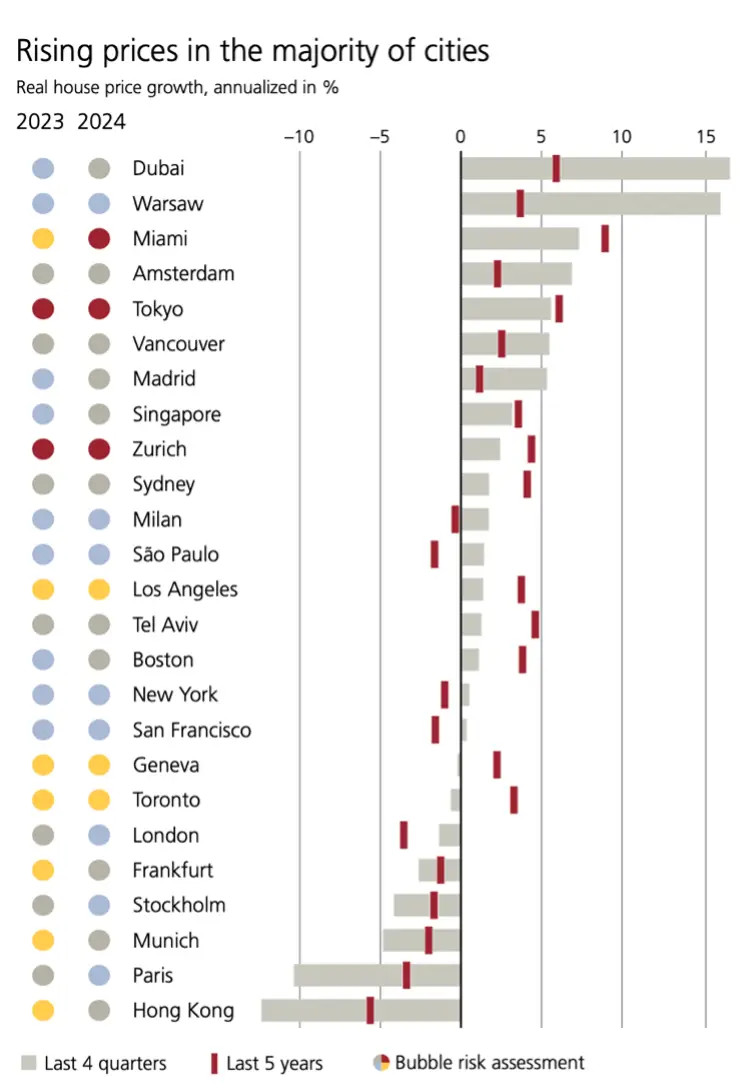
Despite strong capital appreciation in recent years, rental yields in Dubai have grown even more, keeping the market highly attractive for investors. While property prices have surged, rental demand has outpaced supply, driving rents even higher. This has led to rental yields of 5-8%, significantly outperforming global real estate markets where rising prices often lead to lower returns.
Compared to cities like New York (3-4%) or London (2-3%), Dubai’s price-to-rent ratio remains highly favorable for investors. The lack of rental income tax further boosts net returns, making it an ideal market for real estate investors. Areas like Dubai Marina, Downtown Dubai, and JVC see particularly strong rental demand, ensuring consistent occupancy and steady cash flow for landlords.
New York City
New York’s real estate market is renowned for its high prices, particularly in prime areas like Manhattan. As of early 2025, Manhattan’s high-end office spaces have seen leases surpassing $200 per square foot. Residential properties in prime locations often exceed $1,000 per square foot, significantly higher than Dubai’s average.
Paris
Paris’s property market has shown resilience, with slight increases in certain areas. As of September 2024, prices in prestigious arrondissements like the 6th and 7th exceed €14,000 per square meter (approximately $1,500 per sqft), while more affordable districts range below €10,000 per square meter (around $1,070 per sqft).
Amsterdam
Amsterdam’s real estate market has experienced steady growth, driven by limited supply and high demand. As of 2025, average prices in central areas range between €7,000 to €10,000 per square meter (approximately $750 to $1,070 per sqft), positioning it between Dubai and Paris in terms of pricing.
Investing in Dubai’s real estate market offers several advantages:
While the market presents opportunities, investors should be mindful of:
In conclusion, we can state that Dubai’s real estate market continues to stand out as one of the most dynamic and investor-friendly in the world. With strong capital appreciation, high rental yields, and a tax-free environment, the city offers unparalleled opportunities for both local and international buyers.
Unlike many major global cities where homeownership near the center is unattainable for most, Dubai’s price-to-income ratio remains healthy, allowing for sustained demand and long-term market stability.
The market’s growth is driven by a combination of economic expansion, increasing foreign investment, and favorable regulations, ensuring that the rising prices are backed by real demand rather than speculation. Unlike high-risk bubble markets, Dubai still has room to grow, making it a prime destination for real estate investors seeking both capital gains and strong rental returns.
With continued development, world-class infrastructure, and an investor-friendly legal system, Dubai is well-positioned to maintain its upward trajectory. Whether you’re looking to invest, live, or do business, Dubai’s real estate market remains one of the most promising and profitable in the world.

